

Rapid microclimate evaluation | and microclimate data integration in BEM and environmental design
Team
Naga Manapragada, Jonathan Natanian
Years
2022-ongoing
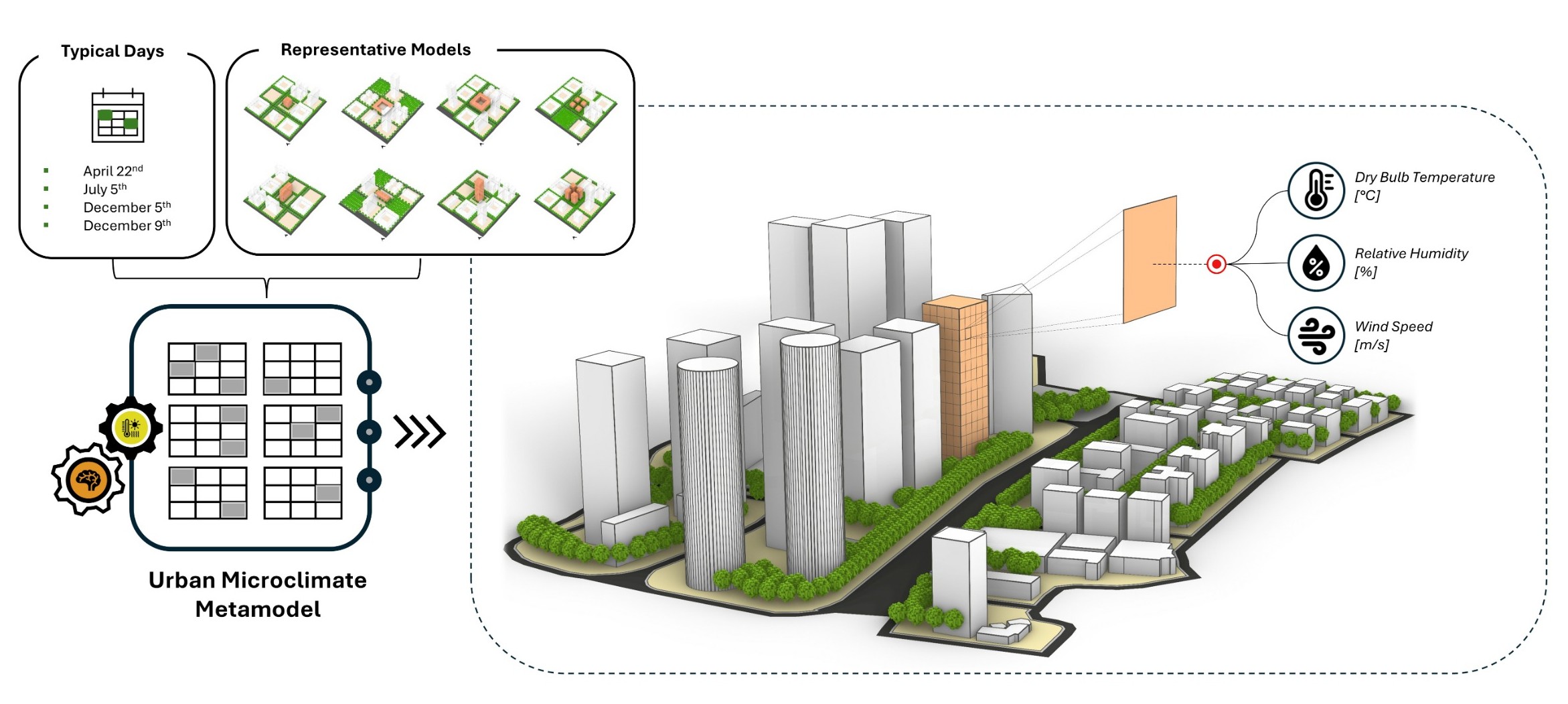
This research introduces a Machine Learning-based framework for generating metamodels that address the computational limitations of CFD-driven urban microclimate modelling tools used to simulate near-surface conditions around buildings. By combining unsupervised learning with advanced sampling strategies, the framework identifies representative climate days and urban block configurations from large parametric design spaces, resulting in compact yet diverse simulation datasets. A key contribution is the development of Directional Exposure Indices (DEIs)-spatial descriptors that capture the orientation, distance, and density of surrounding urban geometry from a given point within the urban canyon. When paired with a custom neural network, these DEIs enable accurate predictions of near-surface air temperature, relative humidity, and wind speed across a wide range of urban morphologies. The framework is designed for scalability and transferability, supported by both domain-specific and numerical validation methods, and can be applied across different climates and urban contexts. Beyond accelerating microclimate simulation workflows, the metamodel also enables two-way integration with building energy models and supports urban form optimization strategies informed by microclimate performance-positioning it as generative tool for responsive design across scales.
Rapid microclimate evaluation | and microclimate data integration in BEM and environmental design
This research introduces a Machine Learning-based framework for generating metamodels that address the computational limitations of CFD-driven urban microclimate modelling tools used to simulate near-surface conditions around buildings.… more
By combining unsupervised learning with advanced sampling strategies, the framework identifies representative climate days and urban block configurations from large parametric design spaces, resulting in compact yet diverse simulation datasets. A key contribution is the development of Directional Exposure Indices (DEIs)-spatial descriptors that capture the orientation, distance, and density of surrounding urban geometry from a given point within the urban canyon. When paired with a custom neural network, these DEIs enable accurate predictions of near-surface air temperature, relative humidity, and wind speed across a wide range of urban morphologies. The framework is designed for scalability and transferability, supported by both domain-specific and numerical validation methods, and can be applied across different climates and urban contexts. Beyond accelerating microclimate simulation workflows, the metamodel also enables two-way integration with building energy models and supports urban form optimization strategies informed by microclimate performance-positioning it as generative tool for responsive design across scales.
Team
Naga Manapragada, Jonathan Natanian
Years
2022-ongoing