

Nature based solutions (NbS) integration | into regenerative design workflows from the building to the city
Team
Eilam Sklar, Hari Priya, Naga Manapragada, Jonathan Natanian
Years
2019-ongoing
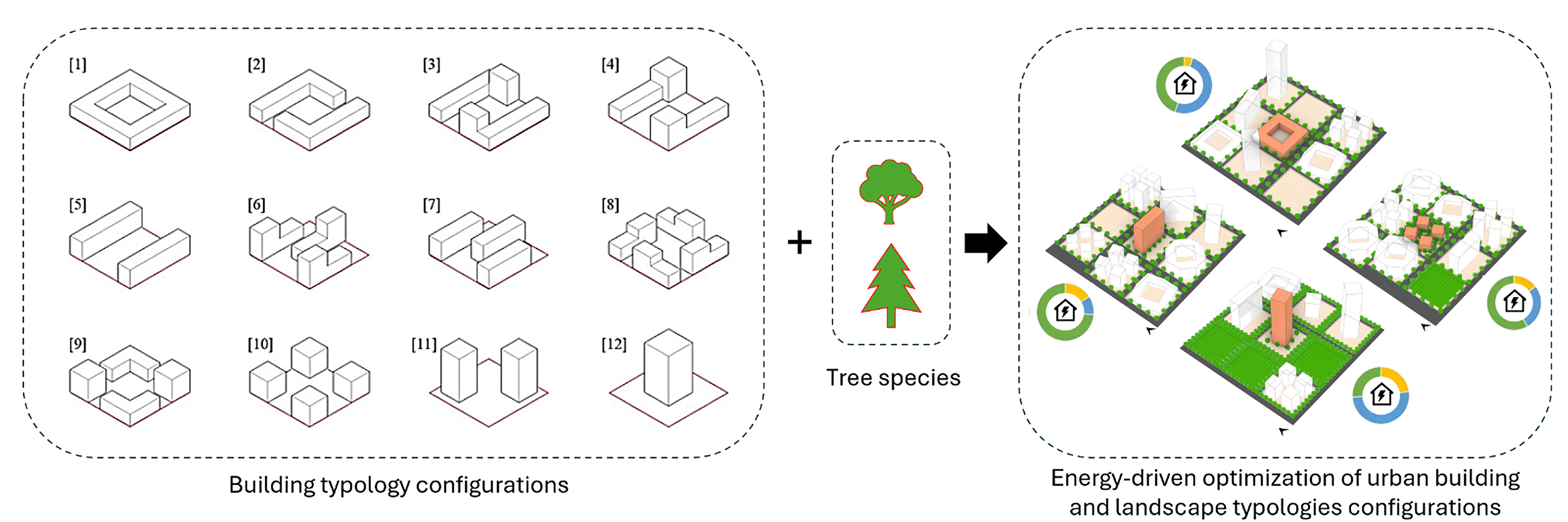
Trees and Vegetation in Building–District Environmental Analytics advances the scientific foundations for nature-based, microclimate-responsive design. Our research develops methods to quantify how vegetation-from individual trees to vertical greenery systems-modulates thermal comfort, shading, evapotranspiration, and building energy demand across scales and climates. Preliminary studies from our lab have demonstrated the potential of vertical greenery systems to balance cooling and energy efficiency through cross-climate optimisation, and introduced microclimate-driven building energy models that explicitly account for tree-generated cooling and dynamic shading effects. Earlier regenerative-design work further established the workflow logic needed to couple microclimate, energy, and ecological indicators in a unified analytical framework. Together, these efforts expose a critical methodological gap: although vegetation is widely used in design, it is rarely integrated into quantifiable, predictive performance workflows capable of guiding decisions at building-to-district scales. Our ongoing research identifies this gap as a key opportunity for advancing evidence-based nature-based solutions, setting the stage for future work in which trees and vegetation become high-impact, performance-driven components of climate-adaptive urban environments.
Nature based solutions (NbS) integration | into regenerative design workflows from the building to the city
Trees and Vegetation in Building–District Environmental Analytics advances the scientific foundations for nature-based, microclimate-responsive design. Our research develops methods to quantify how vegetation-from individual trees to vertical greenery systems-modulates… more
thermal comfort, shading, evapotranspiration, and building energy demand across scales and climates. Preliminary studies from our lab have demonstrated the potential of vertical greenery systems to balance cooling and energy efficiency through cross-climate optimisation, and introduced microclimate-driven building energy models that explicitly account for tree-generated cooling and dynamic shading effects. Earlier regenerative-design work further established the workflow logic needed to couple microclimate, energy, and ecological indicators in a unified analytical framework. Together, these efforts expose a critical methodological gap: although vegetation is widely used in design, it is rarely integrated into quantifiable, predictive performance workflows capable of guiding decisions at building-to-district scales. Our ongoing research identifies this gap as a key opportunity for advancing evidence-based nature-based solutions, setting the stage for future work in which trees and vegetation become high-impact, performance-driven components of climate-adaptive urban environments.
Team
Eilam Sklar, Hari Priya, Naga Manapragada, Jonathan Natanian
Years
2019-ongoing