

Immersive environmental design interfaces | for collaborative environmental data driven design
Team
Amir Malka, Naga Manapragada, Jonathan Natanian
Years
2022-ongoing
Publications
Enhancing Environmental Performance-Driven Design Decisions Through Immersive Exploration
(2025) Malka, A., Manapragada, N.V.S.K., & Natanian, J.
In Proceedings of the 16th annual Symposium on Simulation for Architecture and Urban Design (SimAUD 2025), Madrid, Spain.
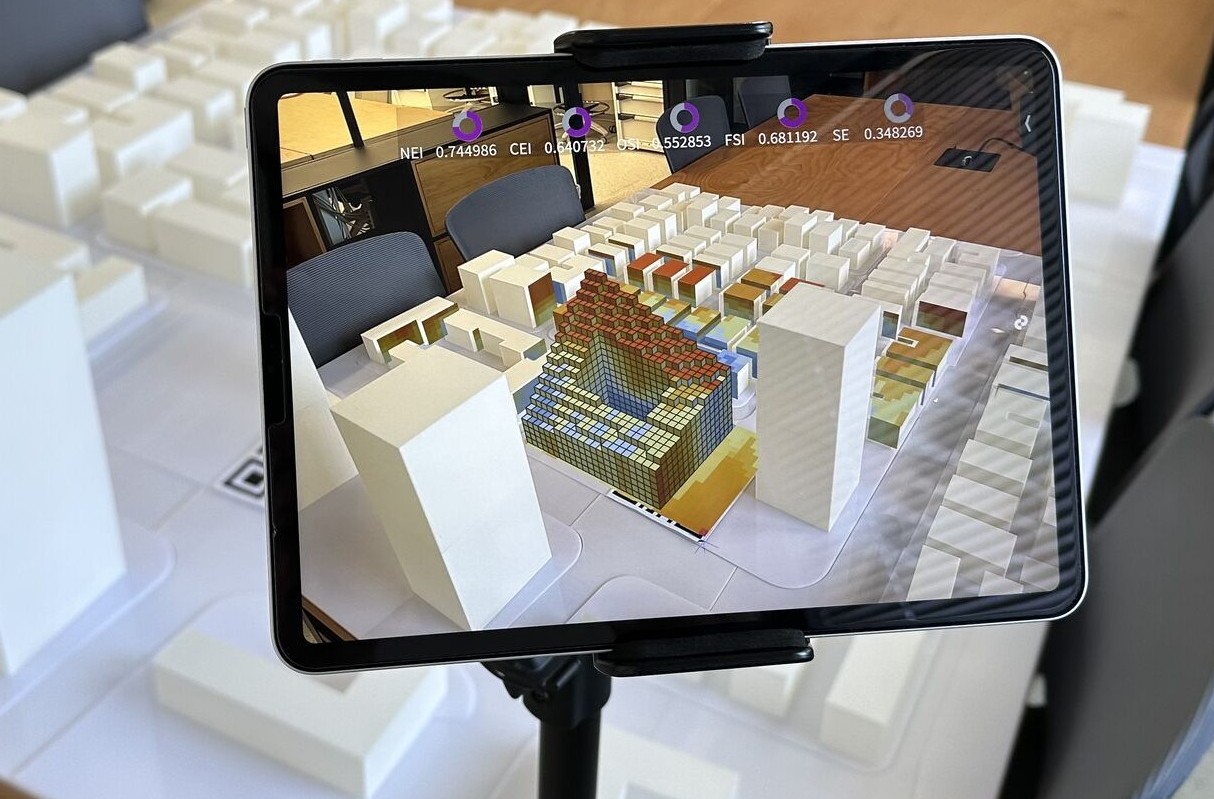
Our lab develops immersive, multi-sensory interfaces that transform complex environmental performance data into shared, collaborative design environments. Building on our extended reality (XR) workflow for exploring parametric design spaces, this research aims to bridge the gap between simulation output and stakeholder understanding. Through XR headsets, large-format touchscreens, and high-performance computing, we construct environments in which energy, microclimate, comfort, solar performance, vegetation effects, and urban form trade-offs can be explored simultaneously and intuitively. These interfaces allow architects, planners, engineers, and community stakeholders to navigate high-dimensional datasets, toggle between KPIs, and visualise spatial implications directly on 3D models-supporting faster, clearer, and more informed decision-making. By integrating outputs from our diverse research themes, this line of work positions immersive analytics as a research pathway in its own right, advancing toward real-time, design-responsive environmental feedback. Ultimately, the goal is to create a unified platform through which environmental intelligence becomes accessible, interactive, and actionable across scales and disciplines.
Immersive environmental design interfaces | for collaborative environmental data driven design
Our lab develops immersive, multi-sensory interfaces that transform complex environmental performance data into shared, collaborative design environments. Building on our extended reality (XR) workflow for exploring parametric design spaces, this research aims to bridge… more
the gap between simulation output and stakeholder understanding. Through XR headsets, large-format touchscreens, and high-performance computing, we construct environments in which energy, microclimate, comfort, solar performance, vegetation effects, and urban form trade-offs can be explored simultaneously and intuitively. These interfaces allow architects, planners, engineers, and community stakeholders to navigate high-dimensional datasets, toggle between KPIs, and visualise spatial implications directly on 3D models-supporting faster, clearer, and more informed decision-making. By integrating outputs from our diverse research themes, this line of work positions immersive analytics as a research pathway in its own right, advancing toward real-time, design-responsive environmental feedback. Ultimately, the goal is to create a unified platform through which environmental intelligence becomes accessible, interactive, and actionable across scales and disciplines.
Team
Amir Malka, Naga Manapragada, Jonathan Natanian
Years
2022-ongoing