

Mixed-use energy-driven optimization | and impacts of diverse district designs on environmental performance in hot climates
Team
Jonathan Natanian, Eilam Sklar, Nora Huberman, Mika Perlshtein
Years
2022-ongoing
Funding agency
Israeli Ministry of Energy
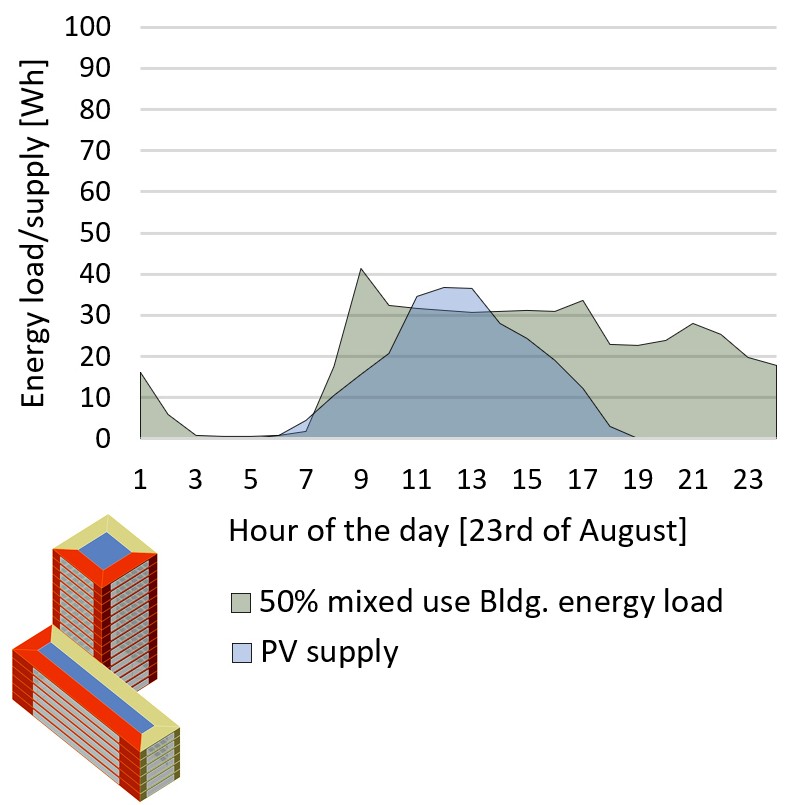
Here we offer a novel computational workflow for assessing and optimising mixed-use districts by integrating typological diversity, programme mix, and environmental performance. A key contribution is a simplified energy-balance metric that, for the first time, links time-dependent occupancy schedules with solar availability on building surfaces, enabling rapid and reliable estimation of district-scale energy behaviour. Embedded within a two-phase workflow that combines high-speed performance screening with detailed simulation and multi-objective optimisation, the method supports exploration of numerous design alternatives and reveals how massing, height variation, and use patterns influence cooling demand, renewable energy potential, and overall performance. By quantifying these relationships efficiently, the project offers planners and designers a practical tool for shaping environmentally responsive, energy-efficient mixed-use districts-particularly relevant for rapidly densifying hot-climate contexts such as Israel.
Mixed-use energy-driven optimization | and impacts of diverse district designs on environmental performance in hot climates
Here we offer a novel computational workflow for assessing and optimising mixed-use districts by integrating typological diversity, programme mix, and environmental performance.… more
A key contribution is a simplified energy-balance metric that, for the first time, links time-dependent occupancy schedules with solar availability on building surfaces, enabling rapid and reliable estimation of district-scale energy behaviour. Embedded within a two-phase workflow that combines high-speed performance screening with detailed simulation and multi-objective optimisation, the method supports exploration of numerous design alternatives and reveals how massing, height variation, and use patterns influence cooling demand, renewable energy potential, and overall performance. By quantifying these relationships efficiently, the project offers planners and designers a practical tool for shaping environmentally responsive, energy-efficient mixed-use districts-particularly relevant for rapidly densifying hot-climate contexts such as Israel.
Team
Jonathan Natanian, Eilam Sklar, Nora Huberman, Mika Perlshtein
Years
2022-ongoing
Funding agency
Israeli Ministry of Energy